
Women and
the Sea Workshop
Colonial Cordage Company [of Ropewalk Lane] Employees, PF-005.007, Colonial Cordage Company Photographs, Maritime History Archive, MUN, St. John’s, NL.
You’re Invited
Since Margaret Creighton and Lisa Norling’s 1996 edited collection, Iron Men and Wooden Women, maritime history has expanded immensely, embracing not just gender but animal agency, coastal histories, riverine and riparian connections, inland seas and bathyscaphe depths, prehistorical oceans and nautical futurisms. But what, in the meantime, has happened to to the women?
In many ways the challenges issued by Creighton and Norling’s volume – the shore’s vitality to shaping seafaring, women’s active and important roles in maritime enterprise, and the varied form and meaning of sailors’ masculinity – have been quite successfully taken up. But what has been the cumulative effect of this expanding scholarship? Women have not been neglected in considerations of gender and the maritime (see particularly the 2022 Jaarboek voor vrouwengeschiedenis, Gender at Sea, edited by Djoeke van Netten). Yet what has changed about what people in and outside the field think or understand of the maritime past?
29 April to 1 May, 2026, in beautiful St. John’s, Newfoundland and Labrador, at the Maritime History Archive, Memorial University of Newfoundland.
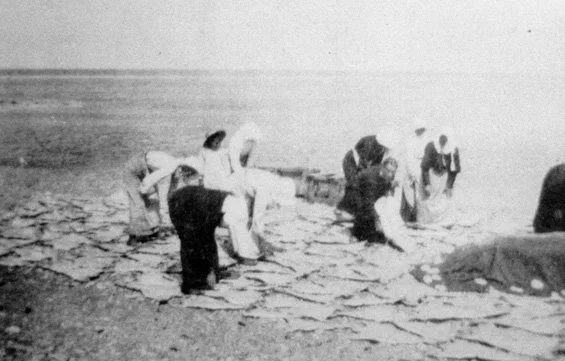
Women Spreading Fish at Grand Bank, Newfoundland. PF-055.2-D57, Capt. Harry Stone Collection, Part 2, Maritime History Archive, MUN, St. John’s, NL.
Many of Jo Stanley’s 2002 critiques about the focus on exceptional women, the pirates, whaling wives, and cross-dressed cabin boys, remain relevant, particularly in popular conceptions of maritime life. As much as scholarly efforts have expanded, the tendency remains to look for women on shore and men at sea. Men’s more prolific accounts of maritime life make masculinity the more accessible facet of gender for analysis, and as a result, works on women and other marginalized identities in maritime spaces have arguably been outpaced. Broader analyses of society, history, and culture, have little reason to move away from reiterations of homosocial heterotopias, bad luck maritime mythologies, and jolly Jack Tar stereotypes.
This workshop will convene scholars focused on women and other marginalized identities in maritime spaces to consider what has been the impact and what is the future of the expansion of maritime studies, particularly those driven by gender, on both scholarly and popular conceptions of maritime life. As part of the Lloyd’s Heritage Foundation-funded SWAAN Project (Seafaring Women Aboard and Ashore Network), this discussion will be folded into a wider consideration of women’s work in modern maritime industries to produce resources for promoting recruitment, bettering retention, and encouraging training of women in careers in these spaces.
The workshop will be held as much as possible in-person at the Maritime History Archive (MHA) at Memorial University in St. John’s, Newfoundland and Labrador, Canada. Time will be spent between discussions, presentations, and opportunities for research and writing in a collegial setting, with trips and sessions organized for developing projects using the resources available at the MHA and in the city of St. John’s more broadly.
The SWAAN project argues that to imagine a future significantly different from the present, we must re-approach the past with new eyes, methods, and ideas. Faculty, independent scholars, early-career and postdoctoral researchers, students, and others interested in women or marginalized identities and subjects in maritime history across spectra and periods are invited to apply.
Please send a 500 word abstract with the subject line: Workshop Application – [Preferred form of Address, Preferred Pronouns]. The abstract should address your research and its connections to and your interest in the workshop subject. Support in the form of accommodation can be provided to some attendees; if requesting accommodation, please include accessibility requirements.
Please do not hesitate to reach out to the organizers at swaanproject@gmail.com with any questions.